A Letter from the Grand Parade — Where History Took Root
Nurture My Land. Honor My Past. Shape My Future.
Days Left
We are no longer accepting donations on this campaign, but there are other ways for you to support us today!
Nurture My Land. Honor My Past. Shape My Future.
Every season brings a new chapter to the land we love. This spring, we invite you to see Valley Forge through the eyes of the land itself—its memory, its scars, and its resilience. The Grand Parade has a story to tell.
This is normally where I would introduce myself, but I'm not quite sure how. These days I am most often called the Grand Parade, which is probably how you know me. At other points in my life I've been called the Stephens family farm, growing grain in the summer to share with those who tended me. A man named David Stephens lived in a stone farmhouse on one of my rolling hills; his son Maurice built an even grander house just down the road.
My first human residents called me Lenapehoking, "homelands of the Lenape," planting maize, beans, and squash in my fertile soil. Before even them, I was home to short-faced bears, saber-toothed cats, and mastodons. Paleontologists would later find their bones in a sinkhole a half mile away, bringing my old friends into the light for the first time in five hundred thousand years.
I was home to a factory for a while, in addition to a farm, so perhaps you call me the Ehret Magnesia Manufacturing Company, the Baldwin-Ehret-Hill Company, or the Keene Corporation. I didn't know that the asbestos in the insulation they were making could harm the lungs of the workers and homeowners, but I could feel it poisoning my land and water. It's taken over twenty years and the labor of many friends to bring that part of me back to life. I still thrill at every new plant that takes root, a sign I am becoming more myself.
The most famous time of my life was the briefest. It was barely winter when they arrived. Men, women, even children—struggling in the mud, carrying what they could in their arms, not dressed for the weather. I was mostly cleared of trees already, being farmland at that time, but what was left was cut down and turned into cabins or thrown into fireplaces and turned into warmth. They were an army in need of a place to rest, to regroup, to see if they could find a way to survive another year.
It was February when the Prussian general arrived. I've since heard people say he arrived grandly, dressed in a silk robe trimmed with fur, in a sleigh bedecked with jingling bells and pulled by Percheron horses, but that's not at all how I remember it. He was certainly intimidating, but there was something else about him—a calculating eye, a ready mind, a spirit determined to turn my collection of raggedy visitors into something greater.
I became a training ground. I turned to mud under their marching feet as they learned to move together. I saw their progress; their numbers increased as they went from what was at first a handful of trainees to an entire army working as one. I heard them fire their guns in a feu de joie when a key alliance with a foreign power was formed that spring. And then they were gone.
Today a statue of that Prussian general overlooks me from atop a hill, the last soldier left. It took several years before I could be a farm once again. And before I knew it, my parcels were being bought up one by one and turned into something new: a state park, where visitors could come and learn about the winter when I welcomed the soldiers. When the country those soldiers were fighting to create turned 200 years old, I was promoted to a national park. That's likely how you know me today, a tribute to one of the many lives I've lived.
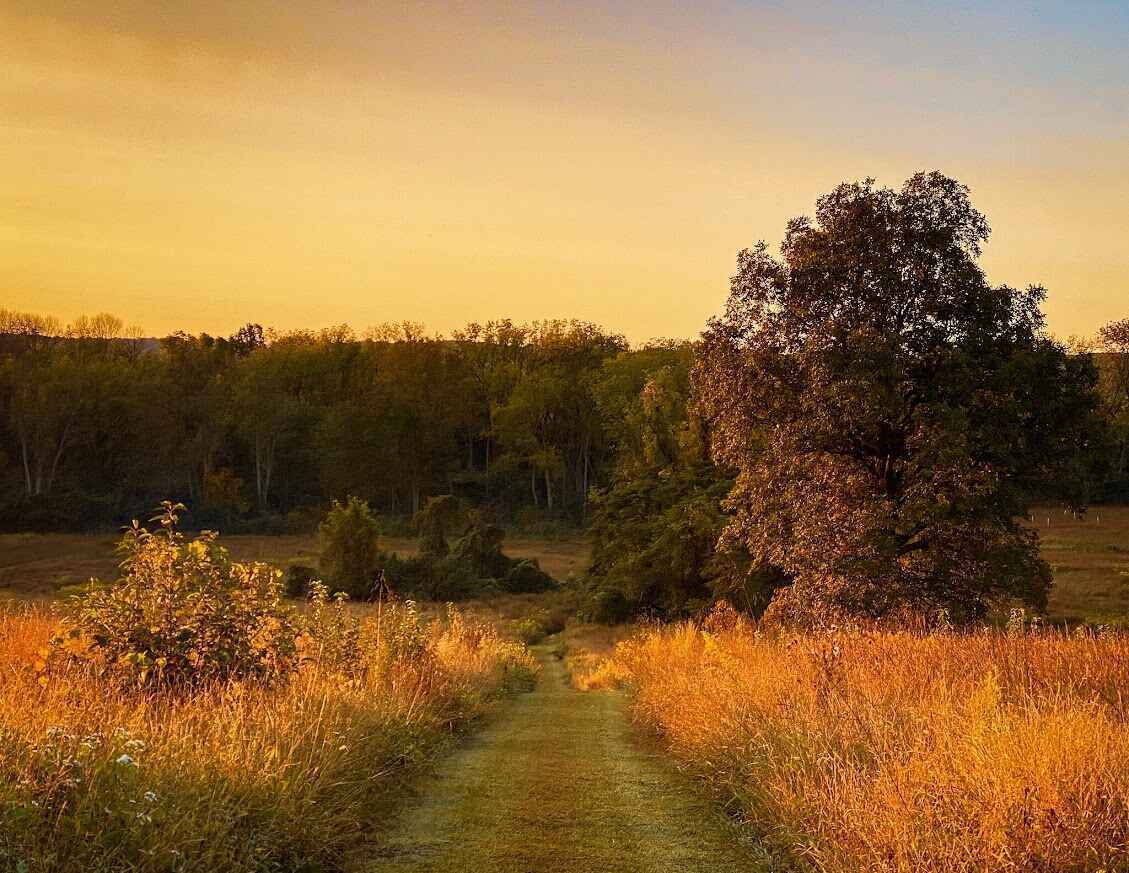
Maybe you've walked my mown paths in the golden afternoon sun, listening to the breeze rustle in the grasses. Maybe you're part of the group that comes in the early mornings, looking through binoculars to see some of the many bird species that call me home. Maybe you sled down my hills when I'm covered in snow or bike along the paths that encircle me. There's been quite a commotion over by the house of the Stephens boy lately—it will be nice to see some life through its windows again when the work is done.
However you choose to visit me, I'm glad you do. You are as much a part of my life as the mastodons, the farmers, the factory, and the soldiers. I'm grateful for the stewards who keep me looking my best, who tend to my upkeep, and who envision what my next life might look like. I know how much work I can be to maintain, and I feel a kinship with everyone who plays a hand in my care. If that is you, thank you. I am grateful for your friendship. I may be here long after everyone around me is gone, but rest assured, I remember you all.
Yours,
The Grand Parade
Will you help shape what comes next?
With your support, we can protect and interpret the Grand Parade for generations to come.
Consider becoming a monthly donor—your steady support nurtures this land year-round.
Thank you for being part of our story.
Photo credit: Photolope Images